

Putting the cart before the horse?
I can’t remember who came up with the idea, but when we started writing the proposal for DECIDE amongst the work packages we naturally said “we should have a management and dissemination work package”, because that’s what all good proposals have. We put in something about informing policy, we put in something about public engagement and dissemination, and we put in something ensuring coherence between all of the work packages. So here I am in “WP4 – translation and evaluation” at the start of the project now trying to figure out what that actually means in terms of day-to-day activities, and (motivated by Lucy) we’re trying to actually do a lot of this from the get-go rather than at the end of the project when everyone has a very selective memory of what happened three years ago. I thought I would start off by describing how we’re starting to try to make sense of what is going on in the project, and some of the mechanisms for dissemination that might be on the table for later on.
One of the deliverables we promised was a blueprint for co-creating CFS and CE initiatives. Lucy and I spent an hour or so talking about it, because while we both know what a blueprint is – a reproduction of a technical drawing or engineering drawing – we’re already into the interdisciplinary fog. Really what we’re talking about is how to articulate the experience, expertise, explicit or tacit knowledge or design principles about what the DECIDE hub is and how it gets put together (or at least all of the best bits) in a way that someone can ultimately use it to make one for themselves – or ideally co-create one with a community of people.
The first question was to what extent we could figure this out now, or whether we should “learn on the job” and then reflect on what happened afterwards. How I have tended to work in the past has been very much the latter, but in this case beyond a broad sense of what we were trying to achieve, and looking to adopt values such as care in our research, none of the team were particularly advocating for a prescribed way of working in an operational sense. We could try and make something now and then apply it ourselves – eating your own dog food, to use a (Microsoft?) phrase that Lucy was blissfully unaware of – but it does seem that we have a great deal of figuring out what the hub should be as an emergent endeavour for that to be practical.
The second question is about how you reason about and encapsulate the sort of practical know how that we might expect to learn along the way, and again here we’re rather looking at a blank slate with even our understanding of who this know how might be *for*. This is unavoidably an interdisciplinary problem as we’re sitting at the intersection of some quite technical life-sciences work, computer science and design/innovation, and also the social sciences. There have been quite a few activities in the Mixed Reality Lab that have found great value in ideation cards for all manner of subjects to cut across disciplines and practices, my amazing friend Richard’s mixed-reality game cards being one of the lab’s first ventures into this, but also responsible innovation, game design, ethical internet of things etc. I’m keen that as we start to figure out these domain-specific issues that ideation cards could provide an accessible and actionable way for practitioners to engage with them. I’m also really taken with my colleague Teresa’s board game It’s All Connected, especially in the way the board game – as games do – represents an entire system in an accessible and interactive manner. Given that the idea of the circular economy could be a little academic, an approach like this could be really valuable closer to the public engagement side of our work.
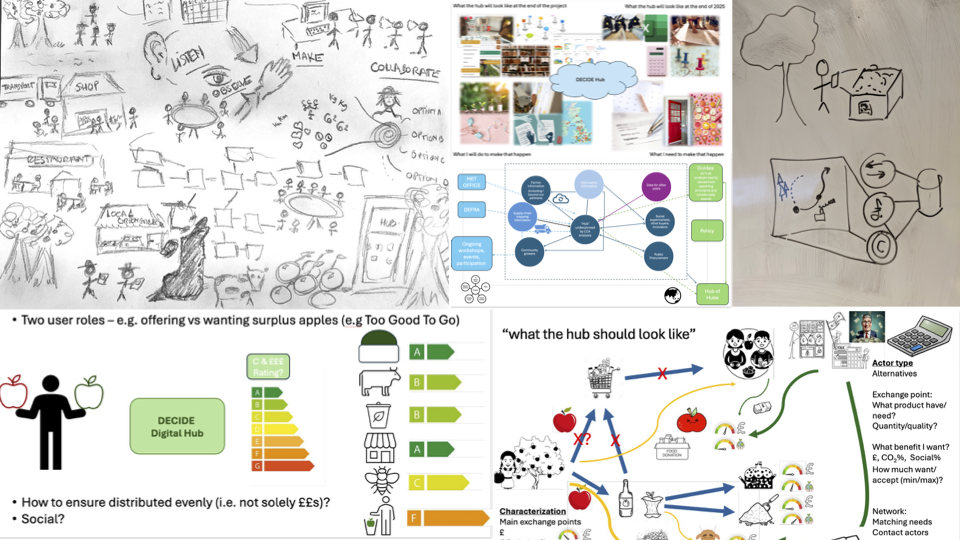
For me, underpinning all of these activities is some holistic vision of what our DECIDE hub looks like, and I don’t mean visually. As above, this comes from my experience of working quite practically and building interesting *things*, but in this case I think I’m referring to the colloquial, shared understanding of what it *is* that we’re building, and this is where this interdisciplinary problem comes to the surface. To this end Lucy and I ran a workshop to ask the project broadly how we envisioned the hub both at the end of the project but also by the end of the year, given that this is the thing or activity around a deployment that is going to yield data, participation, results etc. I have lots of questions about what a deployment will turn out to be – is it closer to an experiment or a piece of in the wild research – how do we bootstrap something that works at a food system level, what the different conceptualisations of the CFS are and whether there is a common articulation or map of a circular apple system we can draw upon, and also what our assumptions are about ownership, ability to deploy and create instances etc. Even in our small team there was a great plurality in how we all chose to articulate what it looks like (some of them are shown above) from people focused, to interface sketches and systems perspectives, so clearly we’ve got a lot of work to do to figure this out.