Understanding the apple supply-chain and trying to model it
For me, it all began with a meeting in Paris in summer 2023 at the sidelines of a conference. What does the apple supply-chain in UK look like? How do we model it? These were some of the questions that did pop somewhere in my mind when Anne and Lucy discussed the idea of this project with me for the first time. I would admit though that the modelling question was not the most pressing one for me at that time, but it’s the one that is occupying me now. The exciting part (research-wise) during this project’s timespan is that like any other meaningful research question, this one as well has had its own complex layers. Perhaps the most important layer that this churn has thrown up, is that of trying to confirm that what should be the purpose of such a ‘model’. If it is going to optimize, then who is it optimizing for? There is of course a technical element to this modelling question (as in what techniques, parameters, formulation etc), but the dive currently is at a more fundamental level – at least for me personally. What exactly do different actors in the apple supply-chain want from this project and can those be modelled in a meaningful way? This isn’t to say that broader objectives from the supply-chain analysis work package are not known, they very much are and have been from the very beginning obviously. In some ways, one could imagine it like planning for a trip. You know the holiday destination you want to get to and the timeline by when you want to get there, but the intriguing (and almost fun!) part is trying to figure out how to get there. Your choice of the route and the tools (the vehicle) is subject to your own driving skills (or limitations), the information (data!!) available for those options, and very importantly what might work for your companions as well who are sharing this journey with you.
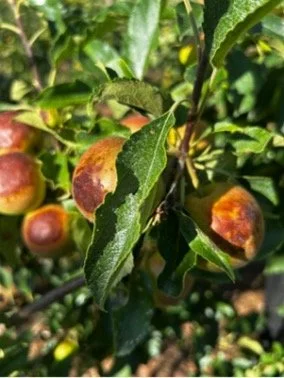
Sunburn on apples, source: https://x.com/GBApples/status/1948715358266773600
The last few months, I’ve learnt a lot while working on this project. There is obviously domain specific learning that comes with working on a research project like this. However, apart from that, interactions with experts from different backgrounds in our multi-disciplinary team has exposed me to some new perspectives that I hadn’t previously thought of. For example: that farmers are more than just economic actors producing and selling a product, that a system-wide view should also include plant-soil-animal interactions within the wider apple supply-chain network, and that designing a digital platform must also take care of questions around how humans interact with digital technologies. Coming back to my own domain, there is a lot remaining for me to know more about the apply supply-chain. More process level data (economic and environmental) to be extracted, more supply-chain interactions and decisions to be mapped, more trade-offs and constraints to be identified. Having said that, even at this stage looking on from a supply-chain perspective in this work package, the challenges in the apple supply-chain seem plenty and are clear to see. The grand challenge is how to get to a supply-chain structure that embeds circularity and uses apple produce, including surplus, in a ‘good’ way? Bearing in mind that the very definition of ‘good’ itself is not quite straightforward to model. A ‘good’ way that captures the welfare of more vulnerable echelons in the wider supply-chain network, as well as that of the wider climate-soil-animal ecosystem. Can it be done? Is there a divergence, or even a tension, between an academic’s version of a ‘good’ solution vs what a farmer thinks for example? These sustainability and circularity challenges are further amplified by the various risks that are present in the apple sector, particularly on the farming end of the supply-chain. There are uncertainties in the yield and rising concerns regarding capacity on the production side as well as on the storage side. Adding to that, there are inflationary pressures on different echelons on the value chain (including the consumption side) which are squeezing the margins of farmers. Perhaps these are some contributing factors behind a slowdown in the new apple plantations across the UK in recent times (source: Largest ever UK apple and pear orchard census). Add to the mix the risks due to fluctuating weather conditions. I recently learned that apples could get sunburn too!! The weather fluctuations in last few weeks alone seem to have caused some crop damage due to high temperatures (Fig. 1) and at the same time some crop damage due hail (Fig. 2), all within the month of July.
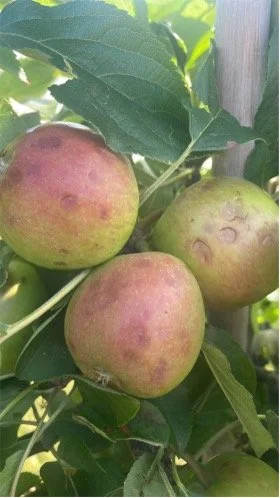
Apples damaged due to hail, source: https://x.com/GBApples/status/1950164887625191918